
Decatur County Projected vs Actual Release
A projection is a calculated or procedural milestone. It is not proof that a person walked out on that date. Tennessee uses several date labels that answer different questions. A court judgment states the sentence. TDOC calculates sentence and eligibility fields for covered felony offenders. The Tennessee Board of Parole decides whether parole should be granted when a person becomes eligible. Finally, release authorization and processing establish the actual state release event.
The exact Tennessee term release eligibility date, often shortened to RED, means the earliest date an eligible felony prisoner may be considered for parole. RED does not mean parole was granted. It is not a booked departure time, sentence-expiration date, or promise of physical release. A grant can still depend on an approved release plan, required conditions, certification, and processing. A detainer can send the person to another custodian instead of the community.
A pretrial detainee at Decatur County Jail has no sentence-based RED or expiration date. Bond, dismissal, acquittal, court order, or later sentencing may change custody, while another hold may prevent release. The clerk's order can explain legal authority, but the jail log supplies the operational release time.
Find a Decatur County Release Date
Start with jurisdiction, not a web calculator. Decatur County Jail records answer county custody questions. TDOC FOIL covers current and former Tennessee felony offenders. The Decatur County Circuit Court Clerk supplies the judgment and jail-credit record. Those sources should agree in role even when their dates differ.
- Determine whether the person is pretrial, serving a county sentence, in TDOC custody, on supervision, or held by another authority. Ask the Decatur County Jail for the destination if the person was transferred.
- For a state felony record, open the TDOC FOIL page. Search the legal name or TOMIS/TDOC number, open each plausible detail, and compare public identity and case fields.
- Copy each displayed field exactly. Keep RED, sentence expiration, parole-hearing data, status, release information, and actual release separate instead of turning them into one date.
- Obtain the judgment, sentence order, and jail-credit information from the Decatur County Circuit Court Clerk. Ask about later amendments or revocation entries if the dates do not fit.
- For a local sentence, ask the jail or the responsible sentence authority for its official calculation. For a covered felony term, TDOC has the statutory calculation role.
- Near the expected event, verify with the custodian and use Tennessee VINE only as an alert. Request the release authorization or release entry when documentary proof is needed.
FOIL may show a photo, current status, location, offense, sentence information, parole-hearing status, and release information, but TDOC says these fields may appear. The live detail controls. Tennessee materials have used terms such as early release date, RED, and sentence expiration in distinct contexts. Preserve the label beside the date and the date viewed.
Note: FOIL does not cover every Decatur County misdemeanor or pretrial booking, so a missing result does not prove release.
Decatur County Release Calculation Layers
A reliable projected release review uses three layers. First comes the court record: judgment, sentence range, offense date, consecutive or concurrent structure, and pretrial jail credit. Second comes the TDOC or local calculation: eligibility, sentence-reduction credit, forfeiture, restoration, and sentence expiration. Third comes the release record: Board action where parole applies, release authorization, processing, and destination.
Each layer can change without the others changing at once. A sentencing document may arrive late. Jail credit can be corrected. Consecutive terms require separate periods of ineligibility to be added. A disciplinary event may cause a deferral or loss of credits. The Board may deny parole even though RED has arrived. A valid detainer can prevent a community exit on the date expected from the sentence alone.
T.C.A. § 40-28-129 assigns TDOC responsibility for calculating sentence-expiration and earliest-release dates for covered felony offenders, including specified local-jail felony sentences. That is why a general calendar tool cannot replace Sentence Management or the official records route. The calculation depends on the judgment and the law that applies to the offense.
Decatur County RED Percentage Rules
T.C.A. § 40-35-501 contains ordinary range calculations as well as later, offense-specific rules. Research identifies mitigated-offender calculations of 20 or 30 percent as specified in the judgment, Range I at 30 percent, Range II at 35 percent, Range III at 45 percent, and career at 60 percent. Those figures do not form one universal formula. Offense type, offense date, sentencing range, and a controlling subsection can override an ordinary range.
The often repeated claim that all Tennessee inmates serve 85 percent is false. Certain listed crimes have an 85 percent floor, while other crimes require 100 percent service. For specified subsection (y) offenses committed from July 1, 2021 through June 30, 2024, there is no release eligibility until 85 percent of the sentence less retained credits, but credits cannot reduce service below 70 percent. For listed offenses committed on or after July 1, 2024, the initial minimum is 85 percent. Credits may reduce the parole-eligibility percentage by no more than 15 percentage points within that rule and do not change sentence expiration.
The release-eligibility statute shown in the captured source should be checked against the judgment and current official Tennessee Code.
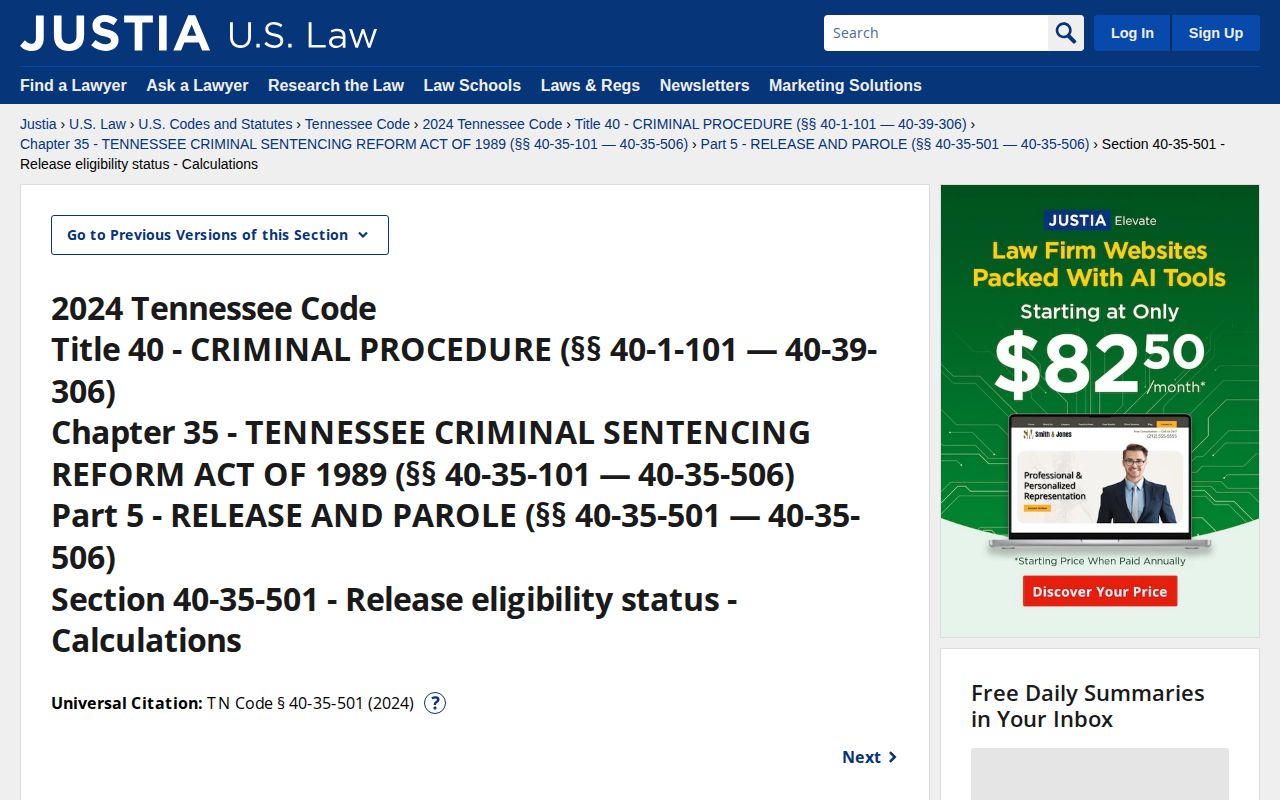
The image documents the statute used to distinguish RED from sentence expiration and actual release. It does not supply a person-specific calculation without the sentence, offense date, range, credits, and other governing facts.
Decatur County Good-Time Release Credit
T.C.A. § 41-21-236 governs Tennessee sentence-reduction credits. Eligible institutional behavior and program performance can result in one to sixteen days per month under the statute's allocations and exclusions. Educational or qualifying treatment achievements can produce one-time credits in eligible cases. Credits are documented, reviewable, and subject to the precise sentence regime.
Credits are not an entitlement and are not the same as an actual release. They can be withheld, forfeited, or restored under lawful process. Discipline may defer RED. For some post-July 1, 2024 rules and mandatory-minimum offenses, credits may affect parole eligibility within the statute but do not shorten sentence expiration. This is one more reason to ask TDOC for the calculation rather than subtracting a set number from the sentence.
Local sentences add a separate layer. Portions of § 41-21-236 apply to covered felony offenders serving at least one year in a local jail and permit documented pre-sentence felony credit. Misdemeanor rules are different. T.C.A. § 41-2-111(b) provides a one-quarter deduction for an uprightly behaving prisoner sentenced to a county jail or workhouse for under one year, subject to the governing sentence and discipline. Only the Decatur County Jail or responsible sentence authority should state the actual local date.
What Changes Decatur County Release Dates
A projected date can change for lawful reasons after it first appears. Some events alter the computation. Others leave the sentence calculation intact but stop physical release. The record should identify which kind of change occurred.
| Factor | Effect on the projected or actual date | Best record |
|---|---|---|
| Pretrial or jail credit | A correction can change time credited toward the sentence. | Judgment, jail-credit record, TDOC calculation |
| Consecutive sentences | Separate ineligibility periods must be added. | Judgments and sentence computation |
| Credit loss or restoration | Discipline and later action can move eligibility. | TDOC sentence and disciplinary records |
| Parole denial or deferment | Eligibility passes without release and later review may be set. | Board final disposition and FOIL |
| Release-plan conditions | A grant may await plan approval, certification, or another condition. | Board and release-authorization records |
| Detainer or hold | One custody episode ends while another custodian takes control. | Release entry with destination and receiving-agency record |
| Court order or recalculation | An amended sentence or corrected data may alter a key date. | Court order and updated official computation |
A departure from Decatur County Jail is also not always release to the community. It can be transfer to TDOC, another jail, federal or immigration custody, or a medical setting. Ask for the release type and destination rather than relying on “not here.”
Note: Record the source, date viewed, exact field label, and destination so later changes can be traced without guesswork.
Decatur County Jail Release Dates
The Decatur County Jail does not publish a verified official roster, projected-date tool, or recent-release archive. For a local sentence, contact the jail at 731-852-3703 and ask who performs the official sentence calculation. Request the named person's booking and release entry, including the date, time, type, and destination. The Decatur County released-inmate search path covers the full county record chain. The jail-specific address published by the county is 38 North East Street, P.O. Box 427, Decaturville, TN 38329.
The court file explains the legal basis. Decatur County Circuit and General Sessions contact is consolidated through the Circuit Court Clerk at 22 West Main Street, Decaturville, telephone 731-852-3125. Ask for the judgment, sentence order, jail credit, and later amendments. A bond order or dismissal may authorize pretrial release, but the jail timestamp confirms when processing finished.
If the jail says the person was sent to TDOC, switch to FOIL. A transfer keeps the person in custody and does not create a county community-release date. If the sentence calculation is disputed or a historical state document is required, use the TDOC archived offender-record request and seek the sentence computation, RED, expiration, and release authorization.
Confirm Decatur County Actual Release
As a projected date approaches, check the responsible custodian instead of assuming the event occurred. TDOC status may remain incarcerated, change to parole or probation, or later become inactive. Board eligibility does not prove a grant, and a grant does not prove the release timestamp. The county jail log or TDOC release record provides the operational event.
Tennessee VINELink can send a release or custody-change alert for a matched record. Register on the correct person, select an available event and contact channel, complete the confirmation, and keep the registration details. Alerts can lag and a reported “release” can be release by detainer to another facility. The Decatur County VINELink inmate search explains the named-person alert path.
Documentary confirmation may require the release authorization under TDOC policy or a narrow public-record request. Ask for the smallest identifiable record, preserve the official label, and request a cost estimate before chargeable work. Tennessee records law does not make every copy instant or free, and confidential content remains protected.
The sound conclusion joins three compatible facts: what the court ordered, what the sentence authority calculated, and what the custodian recorded at release. When those differ, ask the record owner to explain or correct the field. Do not build a private estimate from sentence length alone.